洛谷-拍苍蝇
Norman 有一个给定的 KKK 边形的苍蝇拍。他想知道有多少种放置苍蝇拍的方法,使得这个苍蝇拍的顶点在顶点为 (0,0)(0,0)(0,0) 和 (Xp,Yp)(X_p,Y_p)(Xp,Yp) 的矩形中,并且各个顶点是整点,满足没有一个苍蝇被伤害。其中,整点的定义是横坐标和纵坐标都是整数的点。这个矩形中有 NNN 个苍蝇,每一个苍蝇可以看成一个点 (X,Y)(X,Y)(X,Y)。一个苍蝇会
P6886 [COCI 2016/2017 #3] Meksikanac
题目描述
Norman 有一个给定的 K K K 边形的苍蝇拍。他想知道有多少种放置苍蝇拍的方法,使得这个苍蝇拍的顶点在顶点为 ( 0 , 0 ) (0,0) (0,0) 和 ( X p , Y p ) (X_p,Y_p) (Xp,Yp) 的矩形中,并且各个顶点是整点,满足没有一个苍蝇被伤害。
其中,整点的定义是横坐标和纵坐标都是整数的点。
这个矩形中有 N N N 个苍蝇,每一个苍蝇可以看成一个点 ( X , Y ) (X,Y) (X,Y)。一个苍蝇会被伤害,当且仅当这个苍蝇在这个苍蝇拍的顶点,边或内部。
苍蝇拍不能旋转或翻折。
输入格式
第一行包含三个正整数 X p , Y p , N X_p,Y_p,N Xp,Yp,N,意义同上。
以下 N N N 行,每行包含两个正整数 ( X , Y ) (X,Y) (X,Y),表示第 i i i 个苍蝇的坐标。
接下来一行有一个正整数 K K K 表示多边形的点数。
以下 K K K 行,每行两个正整数 ( X i , Y i ) (X_i,Y_i) (Xi,Yi),表示当苍蝇拍的第一个顶点的坐标为 ( X 1 , Y 1 ) (X_1,Y_1) (X1,Y1) 的时候,其他顶点的坐标。各个顶点是顺次给出的。
输出格式
你需要输出有多少可行的放置苍蝇拍的方案。
输入输出样例 #1
输入 #1
4 5 2
1 3
3 4
4
0 0
2 0
2 2
0 2
输出 #1
4
输入输出样例 #2
输入 #2
5 5 3
1 4
1 3
2 2
3
4 7
6 3
7 6
输出 #2
3
输入输出样例 #3
输入 #3
6 7 2
2 5
4 5
8
1 4
3 3
4 1
5 3
7 4
5 5
4 7
3 5
输出 #3
1
说明/提示
样例解释
样例 1 解释
可以放置的苍蝇拍的位置如下:
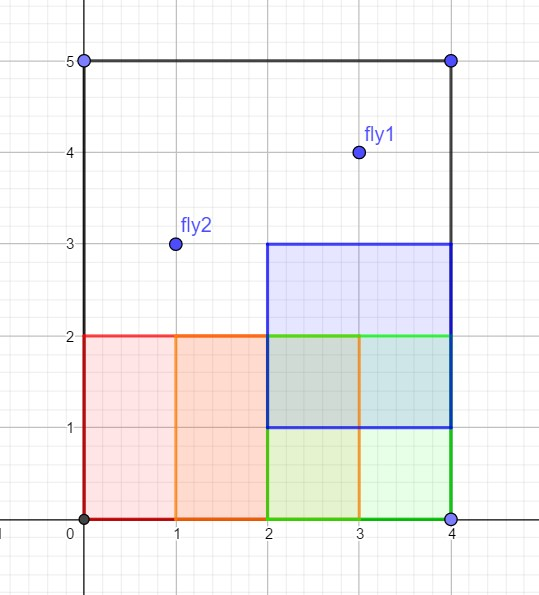
共 4 4 4 种。
样例 2 解释
可以放置的苍蝇拍的位置如下:
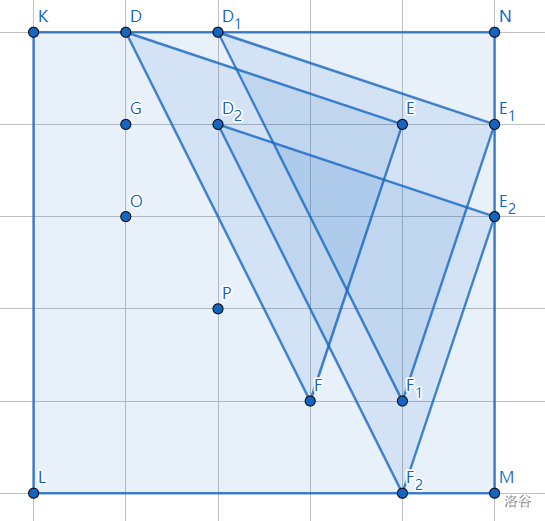
共 3 3 3 种。
样例 3 解释
可以放置的苍蝇拍的位置如下:
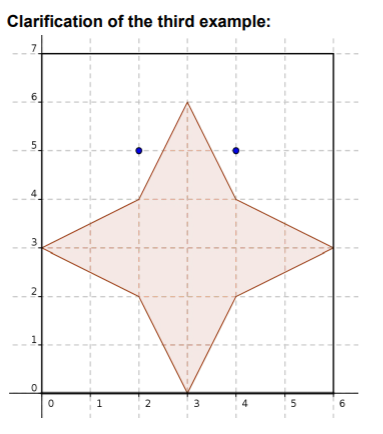
共 1 1 1 种。
数据规模与约定
对于 63 % 63\% 63% 的数据,满足 1 ≤ X p , Y p ≤ 100 1\le X_p,Y_p\le100 1≤Xp,Yp≤100。
对于 100 % 100\% 100% 的数据,满足 1 ≤ X p , Y p ≤ 500 , 1 ≤ N ≤ X p × Y p , 3 ≤ K ≤ 1 0 4 , 0 < X < X p , 0 < Y < Y p , − 1 0 9 ≤ X i , Y i ≤ 1 0 9 1\le X_p,Y_p\le500,1\le N\le X_p\times Y_p,3\le K\le10^4,0<X<X_p,0<Y<Y_p,-10^9\le X_i,Y_i\le10^9 1≤Xp,Yp≤500,1≤N≤Xp×Yp,3≤K≤104,0<X<Xp,0<Y<Yp,−109≤Xi,Yi≤109。
说明
题目译自 COCI2016-2017 CONTEST #3 T6 Meksikanac。
样例 1,2 的解释非官方
def is_on_segment(x, y, x1, y1, x2, y2):
    if x < min(x1, x2) or x > max(x1, x2):
        return False
    if y < min(y1, y2) or y > max(y1, y2):
        return False
    cross = (x2 - x1) * (y - y1) - (y2 - y1) * (x - x1)
    return cross == 0

def point_in_polygon(x, y, polygon):
    n = len(polygon)
    inside = False
    for i in range(n):
        p1 = polygon[i]
        p2 = polygon[(i + 1) % n]
        p1x, p1y = p1
        p2x, p2y = p2
        if (p1y > y) != (p2y > y):
            if p2y == p1y:
                continue
            t = (y - p1y) / (p2y - p1y)
            x_intersect = p1x + t * (p2x - p1x)
            if x < x_intersect:
                inside = not inside
    return inside

def is_point_in_or_on(x, y, polygon):
    for i in range(len(polygon)):
        p1 = polygon[i]
        p2 = polygon[(i + 1) % len(polygon)]
        if is_on_segment(x, y, p1[0], p1[1], p2[0], p2[1]):
            return True
    return point_in_polygon(x, y, polygon)

def main():
    import sys
    input = sys.stdin.read().split()
    idx = 0
    Xp = int(input[idx]); idx +=1
    Yp = int(input[idx]); idx +=1
    N = int(input[idx]); idx +=1
    flies = []
    for _ in range(N):
        x = int(input[idx]); idx +=1
        y = int(input[idx]); idx +=1
        flies.append((x, y))
    K = int(input[idx]); idx +=1
    polygon_original = []
    for _ in range(K):
        x = int(input[idx]); idx +=1
        y = int(input[idx]); idx +=1
        polygon_original.append((x, y))

    x0, y0 = polygon_original[0]
    dx = [x - x0 for x, _ in polygon_original]
    dy = [y - y0 for _, y in polygon_original]

    a_min_candidates = [-dxi for dxi in dx]
    a_min = max(a_min_candidates + [0])
    a_max_candidates = [Xp - dxi for dxi in dx]
    a_max = min(a_max_candidates + [Xp])

    b_min_candidates = [-dyi for dyi in dy]
    b_min = max(b_min_candidates + [0])
    b_max_candidates = [Yp - dyi for dyi in dy]
    b_max = min(b_max_candidates + [Yp])

    if a_min > a_max or b_min > b_max:
        print(0)
        return

    count = 0
    for a in range(a_min, a_max + 1):
        for b in range(b_min, b_max + 1):
            current_polygon = [(a + dx[i], b + dy[i]) for i in range(K)]
            valid = True
            for (x, y) in flies:
                if is_point_in_or_on(x, y, current_polygon):
                    valid = False
                    break
            if valid:
                count +=1
    print(count)

if __name__ == '__main__':
    main()

集算法之大成!助力oier实现梦想!
更多推荐



 25
25 0
0- 0


 已为社区贡献1条内容

所有评论(0)